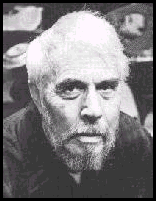
Harry Partch's
Seventeen Lyrics of Li Po
Stephen Kalm, Intoning Voice
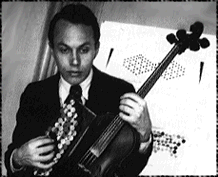
Ted Mook , tenor violin
"The Tzadik disc is welcome simply because it is the first new issue of Partch's music in a couple of decades. The recorded sound is far and away the finest of any Partch disc..."
(American Record Guide, Sept./Oct. 1996)
Total time: 36:46

- The Long Departed Lover 1:30
- On the City Street :39
- An Encounter in the Field :53
- The Intruder 1:14
- On Ascending the Sin-Ping Tower 1:47
- In the Springtime on the South Side of the Yangtze Kiang 3:32
- The Night of Sorrow 1:46
- On Hearing the Flute in the Yellow Crane House 1:58
- On Hearing the Flute at Lo-Cheng One Spring Night 1:46
- A Dream 5:49
- On Seeing Off Meng Hao-Jan 2:26
- On the Ship of Spice-wood 3:09
- With a Man of Leisure 1:10
- A Midnight Farewell 1:49
- Before the Cask of Wine 2:52
- By the Great Wall 2:03
- I am a Peach Tree 2:17
PROGRAM NOTES:
"I am first and last a composer. I have been provoked into
becoming a musical theorist, and instrument builder, a musical apostate, and a
musical idealist, simply because I have been a demanding composer.
I hold no wish for the obsolescence of the widely heard instruments and
music. My devotion to our musical heritage is great -- and critical. I feel
that more ferment is necessary for a healthy musical culture. I am endeavoring
to instill more ferment." --Harry Partch 1942
 In 1930, the composer Harry Partch (1901-1974) broke with Western European
tradition and forged a new music based on a more primal, corporeal integration
of the elements of speech, rhythm and performance using the intrinsic music
found in the spoken word, the principles of acoustic resonance and
just-intonation. Borrowing from the intonation systems of the ancient Greeks,
he created a scale of 43-tones per octave, in part to enable him to capture the
nuances of speech in his music, and to forge purer harmony.
In 1930, the composer Harry Partch (1901-1974) broke with Western European
tradition and forged a new music based on a more primal, corporeal integration
of the elements of speech, rhythm and performance using the intrinsic music
found in the spoken word, the principles of acoustic resonance and
just-intonation. Borrowing from the intonation systems of the ancient Greeks,
he created a scale of 43-tones per octave, in part to enable him to capture the
nuances of speech in his music, and to forge purer harmony.
His unique ideas forced him to become a theorist, an inventor of musical
instruments and a brilliant spokesman for his ideas. Living on the fringes of
society, he was ignored by the standard musical institutions, although after
reading some of his more barbed criticisms of musical culture one can
understand how his presence might have disrupted the smooth indoctrination of
good musical soldiers. He rejected ossified concert traditions, the 12-tone
equal-temperament scale and the idea of "pure" or abstract concert music. He
redefined the roles of the performing musician, composer and by extension,
even the role of music in society . His body of work is rigorously constructed,
sensual, alluring and emotional, and, sad to say, almost impossible to hear
live, since it requires Partch's own invented instruments to be performed.
The Seventeen Lyrics of Li Po were composed between 1931 and 1933 and
are among Partch's earliest extant compositions. They were composed for
Intoning Voice and Partch's Adapted Viola, a hybrid instrument consisting of a
cello neck grafted onto the body of a viola, its open strings sounding one
octave below the violin. He used texts from the eighth century Chinese poet, Li
Po, selected from Shigeyoshi Obata's 1928 English translation, The Works
of Li Po, the Chinese Poet.
In Partch's own words:
"The Lyrics by Li Po are set to music in the manner of the most
ancient of cultured musical forms. In this art, the vitality of spoken
inflection is retained in the music, every syllable and inflection of the
spoken expression being harmonized by the accompanying instrument. The music
accompaniment, or, more properly, complement, in addition to being a
harmonization, is an enhancement of the text-mood and frequently a musical
elaboration of ideas expressed" ...from Partch's liner notes for six of the
Li Po settings for an acetate recording
In this recording, the instrument used in place of the Adapted Viola is a tenor
violin, a member of the new Violin family of instruments, invented, built and
maintained by Carlene Hutchins of the Catgut Acoustical Society. The tenor
violin has the identical tuning of Partch's Adapted Viola, with the advantage
of a greater string length and a larger, more resonant body, better suited to
the instrument's range.
This is the first recording of all seventeen of Partch's Lyrics of Li Po. The
project was arduous. Written transcriptions from Partch's original notation
were prepared, an instrument that could duplicate the range of Partch's Adapted
Viola was found, a suitable way of achieving the flattened bridge effect was
rigged (Partch calls for a flattened bridge in several of the songs, allowing
the simultaneous sounding of three strings), and the laborious process of
making sense out of Partch's meticulous notation was begun. Since there are
almost no notated rhythms in the entire piece, every interpretive choice was
threaded between two known excesses: to not submerge the text in a wash of
"bel canto vowels", and other "devitalized tricks of 'serious singing'", and
to not slight Partch's careful harmonies. The improvisatory performances on
this disc are but one set of possibilities, here offered as a tribute to the
magnificent merger of two great creators, Harry Partch and Li Po.
Program notes by Ted Mook
Produced by Ted Mook
Executive Producer: John Zorn
Recorded at Sound on Sound Studio July 15, 1995
Dave Amlen engineer, TK assistant engineer
Edited and Mastered by Allan Tucker at Foothill Digital, NYC Sept. 8, 1995.
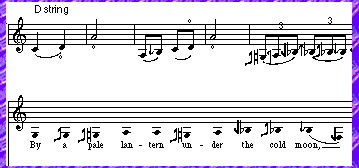 Partch's original score for the Lyrics of Li Po was notated on 3 staves. The top line
showed the approximate 12-tone Equal Temperament equivalent pitch, the second
line was transposed for Partch's Chromelodeon, which reproduced his 43-tone per
octave scale in Just Intonation, and the third (bottom) line was scored in
strict ratio notation for the Adapted Viola. The transcription pictured above
compiles Partch's three different scoring methods into two lines of standard
Western notation, using micro-tonal diacritical marks to indicate the
necessary pitch adjustments. This microtonal system was invented by composer
Ezra Sims, and resolves each pitch of Partch's 43-tone source scale to within
three cents, and simultaneously offers an easy means to recognize Partch's
unique brand of chromatic intervallic relationships to people not accustomed to
working in ratios.
Partch's original score for the Lyrics of Li Po was notated on 3 staves. The top line
showed the approximate 12-tone Equal Temperament equivalent pitch, the second
line was transposed for Partch's Chromelodeon, which reproduced his 43-tone per
octave scale in Just Intonation, and the third (bottom) line was scored in
strict ratio notation for the Adapted Viola. The transcription pictured above
compiles Partch's three different scoring methods into two lines of standard
Western notation, using micro-tonal diacritical marks to indicate the
necessary pitch adjustments. This microtonal system was invented by composer
Ezra Sims, and resolves each pitch of Partch's 43-tone source scale to within
three cents, and simultaneously offers an easy means to recognize Partch's
unique brand of chromatic intervallic relationships to people not accustomed to
working in ratios.
The font used for the diacritical marks is a postscript font, named MICRO, useful in making computer score transcriptions of micro-tonal music. It is quite easy to describe a 72-note division of the octave with this system, and if your computer notation program will support the importation of fonts, it works easily. . For more information about this shareware font, see the sample page.
View a full page of sample score.
Stephen Kalm, Intoning Voice
Baritone Stephen Kalm has sung with many of America's leading regional opera
companies and symphony orchestras, including the Houston Grand Opera,
Chautauqua Opera, Lake George Opera Festival, Minnesota Opera, Connecticut
Opera, The Pennsylvania Opera Theater, and the Milwaukee, Springfield, and
Billings Symphony Orchestras. Among his roles performed are Figaro in The
Barber of Seville, Marcello in La Boheme, Papageno in The Magic Flute, and
Mercutio in Romeo and Juliet. Internationally, Mr. Kalm received critical
acclaim for his solo's in Orff's Carmina Burana with the Filharmonica de
Bogota, as the Subjective Voice in Harry Partch's US. Highball with
Newband in Berlin, and creating the role of Franco Hartmann in Meredith Monk's
Atlas, which he has also recorded for ECM. He can also be heard on New World
Records' Ponder Nothing, singing Five Fragments by Ben Johnston. Mr. Kalm
teaches voice and directs the opera workshop at the University of Montana.